



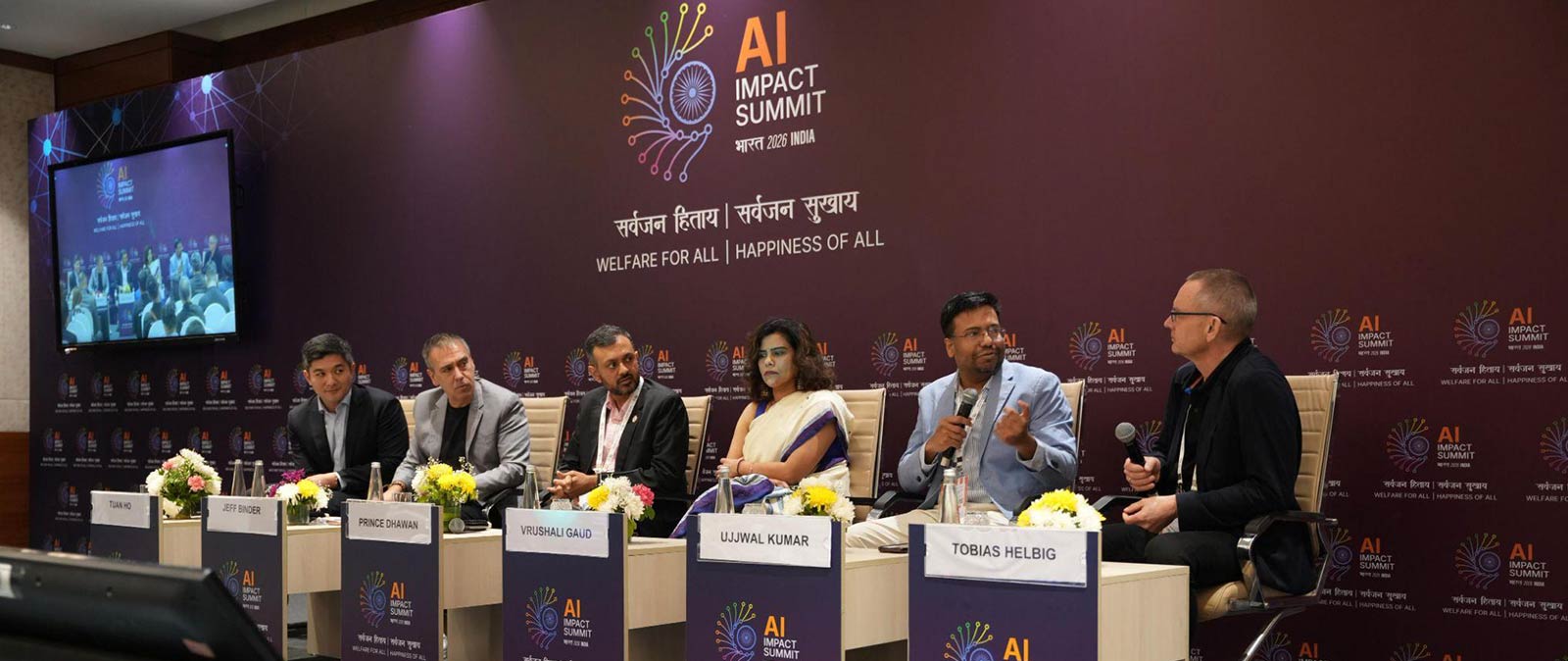
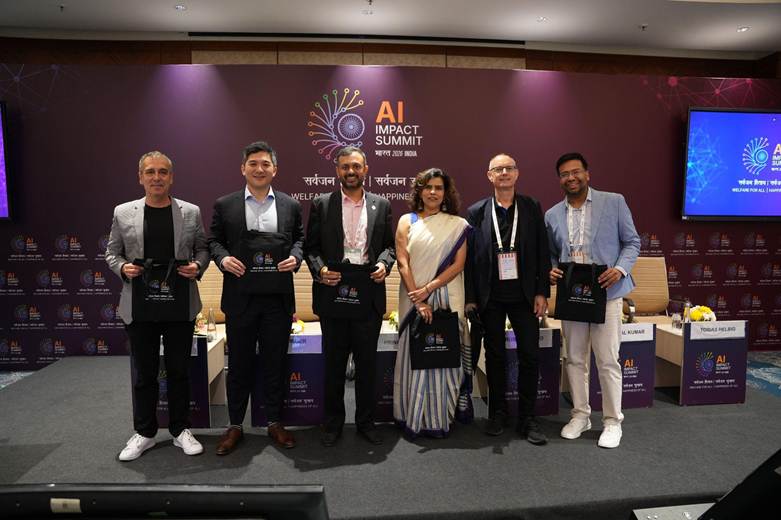
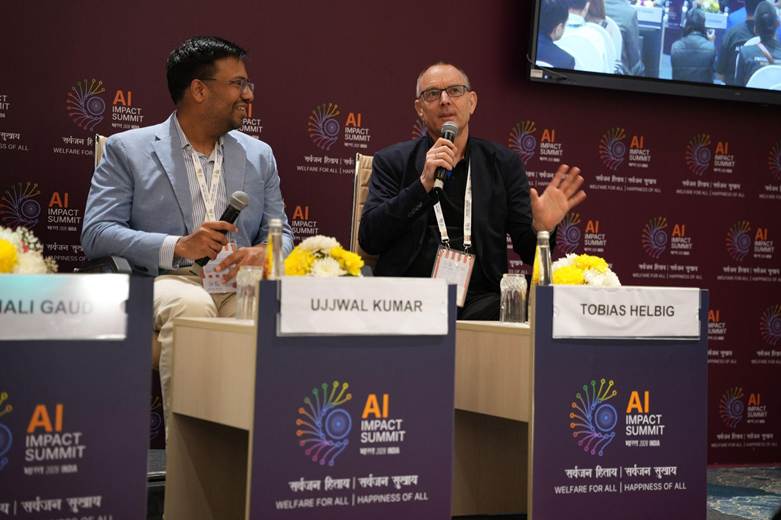
Ujjwal Kumar (second from right) moderates the AI Infrastructure panel at Bharat Mandapam alongside Tuan Ho (Xfund), Jeff Binder (Harvard Venture Partners), Prince Dhawan, IAS (REC Limited), Vrushali Gaud (Google), and Dr. Tobias Halberg (NXP Semiconductors). New Delhi, February 2026.
Founder & CEO, Quantum Alliance | Co-Founder, Cognisee AI | Non-Resident Tutor, Harvard University
"If You Don't Control the Atoms, You Don't Control the Bits."
The India AI Impact Summit 2026 was the largest AI gathering ever held in the Global South. Over 100 country delegations, twenty heads of state, and more than $200 billion in investment commitments across the AI stack. Prime Minister Modi and French President Macron co-inaugurated the event at Bharat Mandapam, with UN Secretary-General Antonio Guterres also addressing the opening ceremony. Sam Altman, Sundar Pichai, Dario Amodei, and Demis Hassabis delivered keynotes; 92 countries endorsed the New Delhi Declaration on AI Impact. And on the final day, India signed the Pax Silica Declaration, joining a US-led coalition of 11 nations to secure the global technology supply chain from critical minerals to frontier AI.
FLAME alumnus Ujjwal Kumar made a distinguished contribution, moderating two panels and speaking on a third, spanning AI infrastructure, legislative governance, and smart cities.
In conversation with us, Ujjwal spoke about his experience of engaging with diverse voices across the summit.
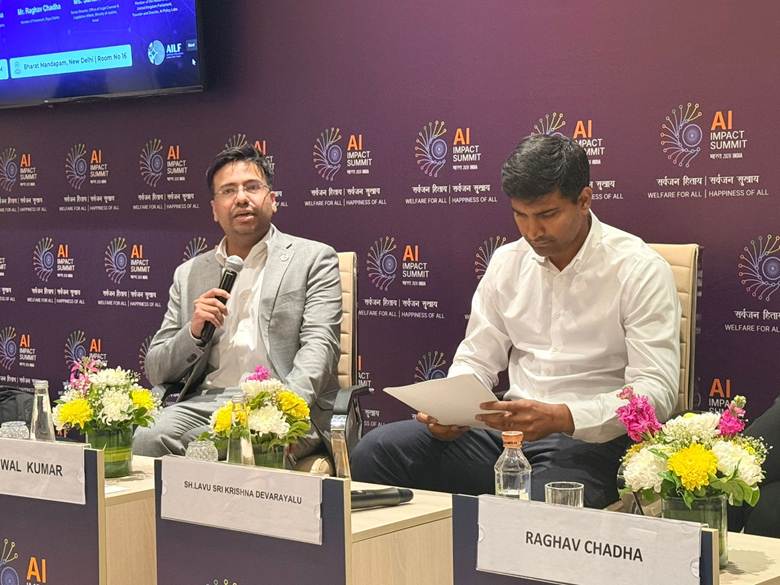 Ujjwal Kumar moderating the ‘Power, Protection, and Progress’ legislative governance panel alongside Shri Lavu Sri Krishna Devarayalu (Member of Parliament, Lok Sabha, Narasaraopet, Andhra Pradesh) and Shri Raghav Chadha (Member of Parliament, Rajya Sabha, Punjab). Bharat Mandapam, New Delhi, February 2026.
Q1. You work at the intersection of AI, innovation, and global partnerships. What is the core focus of your work today?
The AI era will be won in mines, grids, and supply chains. Not in model labs.
The talent to work on that layer is sitting in universities right now. Most of them have no idea these problems exist. Consumer tech spent fifty years building an ecosystem to point the best minds at a specific category of problem. Nobody built that ecosystem for the physical foundations of AI. The raw material has always been there. The signpost hasn't.
That gap is what I am working on. We back the founders and researchers working on these problems and build the pathways that didn't exist. Q-Fellows is the program at the center of it - ten weeks, a real problem, a funded trek to where it physically lives, backed by Eric and Wendy Schmidt and Harvard Salata Institute.
Somewhere right now there is a problem that has been waiting for the right person. Q-Fellows is where they find each other.
Q2. What drew you to this space, and what problem are you most passionate about solving?
I kept noticing the same thing.
The most important problems of our time had almost nobody working on them. Not because they were unsolvable. Because they were invisible to the people most capable of solving them. The path in didn't exist.
AI made that gap impossible to ignore. The physical layer - minerals, grids, supply chains, went from a niche concern to the most contested terrain in geopolitics almost overnight. And still the best minds were being pointed somewhere else entirely.
That is what I cannot walk away from.
Q3. From your vantage point, what is the most significant shift currently shaping the global AI ecosystem?
Two years ago, critical minerals were a supply chain problem. Now they are a sovereignty problem. That word change is everything.
Governments stopped asking whether AI matters and started asking who controls it. That is a different question. It has different answers. And it happened faster than anyone predicted. Critical minerals went from a niche concern for defense analysts to India's union budget, US trade negotiations, and emergency EU legislation in eighteen months.
The shift that stays with me came from Vrushali Gaud at Google, in my panel. The boring infrastructure investments, grids operating better, clean energy transitions, are just good things to do regardless of the hype cycle. Not because of AI. Despite AI. That means the work is durable in a way that model generations are not. Infrastructure bets made now will outlast whatever model is dominant in five years.
Most people are still looking at the wrong layer.
Q4. You were part of the India AI Impact Summit 2026. How would you describe the significance of this forum in today's AI landscape?
Every previous AI summit was about what AI could do. The most important conversations at India 2026 were about what AI needs.
India was the first Global South country to host this summit series after Bletchley Park, Seoul, and Paris. 92 countries endorsed the New Delhi Declaration. That is not symbolic positioning. That is the world registering a shift in where the center of gravity of the AI era is moving.
The panels that defined the event, not the ones that got the coverage but the ones that mattered, were on critical minerals corridors, intelligent grid architecture, supply chain sovereignty. Those were the panels I moderated. On the final day, US Ambassador Sergio Gor articulated the entire thesis of my panel in one sentence: the coalition secures the chain from the mines where we extract critical minerals to the fabs where we manufacture chips to the data centers where we deploy frontier AI. The room had spent four days building to that sentence.
The Global South is not catching up. It is making choices that will define what catching up even means.
Q5. You participated in conversations spanning innovation and legislative engagement. Why is it important for technologists and policymakers to be in the same room?
I opened my legislative panel with a frame from my professor at Harvard Kennedy School, Bruce Schneier: democracy at its core, is an information system. AI changes how information is shaped, amplified, and acted upon. That makes it a democracy question more than a technology question. Once you accept that, you cannot keep technologists and policymakers in separate rooms.
Technology moves in quarters. Policy moves in years. The only way to close that gap is not faster regulation. It is an earlier conversation, with shared mental models built before the decisions are made, not after. Reports do not build shared mental models. Rooms do.
The proof was on my legislative panel. Raghav Chadha, a member of parliament, said something that stopped the room: AI will lead not just to job displacement but to knowledge displacement. Anything not digitized, not codified, AI will not apply itself to.A parliamentarian arriving at that insight, in that room - that is what happens when you build the right room.
"Technology moves in quarters. Policy moves in years. The only fix is not faster regulation. It is an earlier conversation."
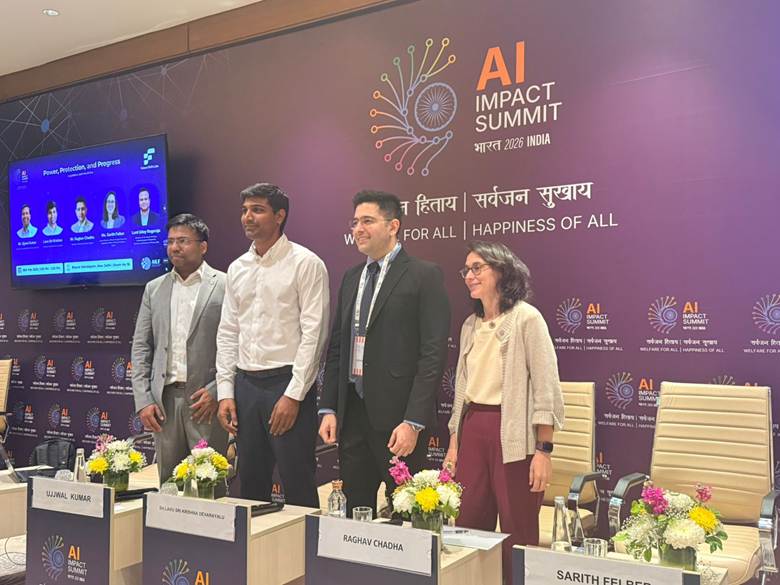 Ujjwal Kumar with Shri Lavu Sri Krishna Devarayalu (Member of Parliament, Lok Sabha), Shri Raghav Chadha (Member of Parliament, Rajya Sabha), and Sarith Felber (Head, Law and Technology Division, Ministry of Justice, Israel; following the ‘Power, Protection, and Progress’ legislative governance panel. Bharat Mandapam, New Delhi, February 2026.
Q6. One of the themes discussed was sovereign AI and international collaboration. How do you see India positioning itself globally in this moment?
India is making a bet most countries haven't had the courage to make. That sovereignty and collaboration are not opposites. The evidence is in the architecture.
What struck me moderating those panels was how many of the hard infrastructure decisions India has already made. Domestic compute capacity. Allied coalition membership. Indigenous models. Cross-border research partnerships. Each one a different layer of the same stack. Most countries are picking one. India is building all of them simultaneously.
I first met Sam Altman when we hosted him at an Xfund event at Harvard. Two years ago he was skeptical about India. At the summit he called India a full-stack AI leader. That phrase is doing more work than it appears to. Full-stack means you are not dependent on any single layer controlled by someone else. That is what sovereignty actually looks like in practice. Not isolation. Optionality.
Most nations are still choosing. India has already chosen.
Q7. What was one insight or takeaway from the summit that stayed with you?
The line that stayed with me came from Prince Dhawan, IAS, building India's Energy Stack. Almost in passing he said: AI needs not just electrons but intelligent electrons. The grid itself has to think.
That sentence does more work than it appears to. More power is never the answer. A different architecture is. That is true across every layer of the AI stack - not just energy.
Dr. Tobias Halberg at NXP extended it further. AI is moving from perceiving to thinking to acting. We are entering the third phase. Agents in the real world. Intelligence embedded in physical infrastructure. The more AI moves into the physical world, the more the physical world has to be ready for it.
Most people are racing to build smarter models. Almost nobody is building the world those models will need to act in.
"AI needs not just electrons but intelligent electrons. More is never the answer. A different architecture is the answer."
Q8. For students aspiring to work in AI or emerging technologies, what foundational skills matter most?
Learn to work on problems with no established career path. Almost every important problem in AI infrastructure right now has no obvious first job and no clear ladder. The people doing the most consequential work largely invented their own role.
One specific skill: learn to translate between worlds. Technical and political. Local and global. The person who can sit with a government minister in the morning and an engineer at a processing facility in the afternoon and make both conversations count is the rarest person in any serious room right now.
Find the problem you cannot stop thinking about. Move toward it before the path is clear. The path becomes clear through the moving.
Q9. What would you tell a first-time founder looking to build in the AI infrastructure space?
Start with the problem, not the technology.
Infrastructure businesses have an advantage most founders don't see. The problems are not invented. They are not manufactured by clever marketing. A rare earth magnet supply chain that runs through a single country is a problem. A grid that cannot coordinate dynamically at scale is a problem. These things are real and legible in a way that most software opportunities are not.
The founders who will win in this space are not the ones who arrived with the best technology. They are the ones who understood the problem so completely that the solution became obvious. That takes time on the ground. In the mine. At the substation. In the ministry. Most people skip that part.
That is exactly why the opportunity is still open.
Q10. How important is interdisciplinary thinking in a technology-driven world? As a FLAME alumnus, what would you say to students who hope to contribute meaningfully to this space?
It is not a nice-to-have. It is the whole game.
Parag sir co-founded India's first liberal arts university on a conviction I only fully understood years later: that the world's most important problems don't sit inside a single discipline, and neither should the people trying to solve them. That shaped everything about how FLAME taught - not to prepare you for a known destination but to prepare you to find the destination itself.
I did not fully understand what FLAME was building while I was inside it. I understood later, in rooms where everyone else knew one thing very well and I kept asking questions that crossed the walls between disciplines. Those questions were not a liability. They were the whole point.
The problems I work on do not respect disciplinary boundaries. A critical minerals corridor is a geology problem, a geopolitics problem, a financing problem, and a community trust problem simultaneously. You cannot solve it from inside a single department.
To FLAME students specifically: the breadth you were given is not something to apologize for in a technical room. It is your edge. The people who will shape this era are not the ones who knew the most about one layer. They are the ones who could see how all the layers talked to each other.
I understood that the moment I stopped asking which discipline I belonged to and started asking which problem needed solving.
"If you don't control the atoms, you don't control the bits. Everyone is racing to build the smartest model. But the real bottleneck, and the real opportunity, is everything underneath."
Ujjwal Kumar | India AI Impact Summit 2026
ABOUT UJJWAL KUMAR
Ujjwal Kumar is Founder & CEO of Quantum Alliance, based in Cambridge, MA, which works with universities, industry, and governments to back the next generation of builders working on infrastructure-scale challenges in critical industries. He is co-founder of Cognisee AI, a Public Benefit Corporation building Sovereign Second Brains: systems that capture the tacit knowledge experts carry but cannot articulate, preserving it as computable intelligence that compounds over time. He serves as Non-Resident Tutor at Harvard's Quincy House. A FLAME alumnus, he has worked with the UN FAO across diplomatic and development contexts spanning multiple countries, and is an alumnus of the German Federal Foreign Office and Harvard University. Q Fellows, the flagship fellowship program, is backed by the Salata Institute for Climate and Sustainability at Harvard University, Eric and Wendy Schmidt, and Stanford Mineral-X.