



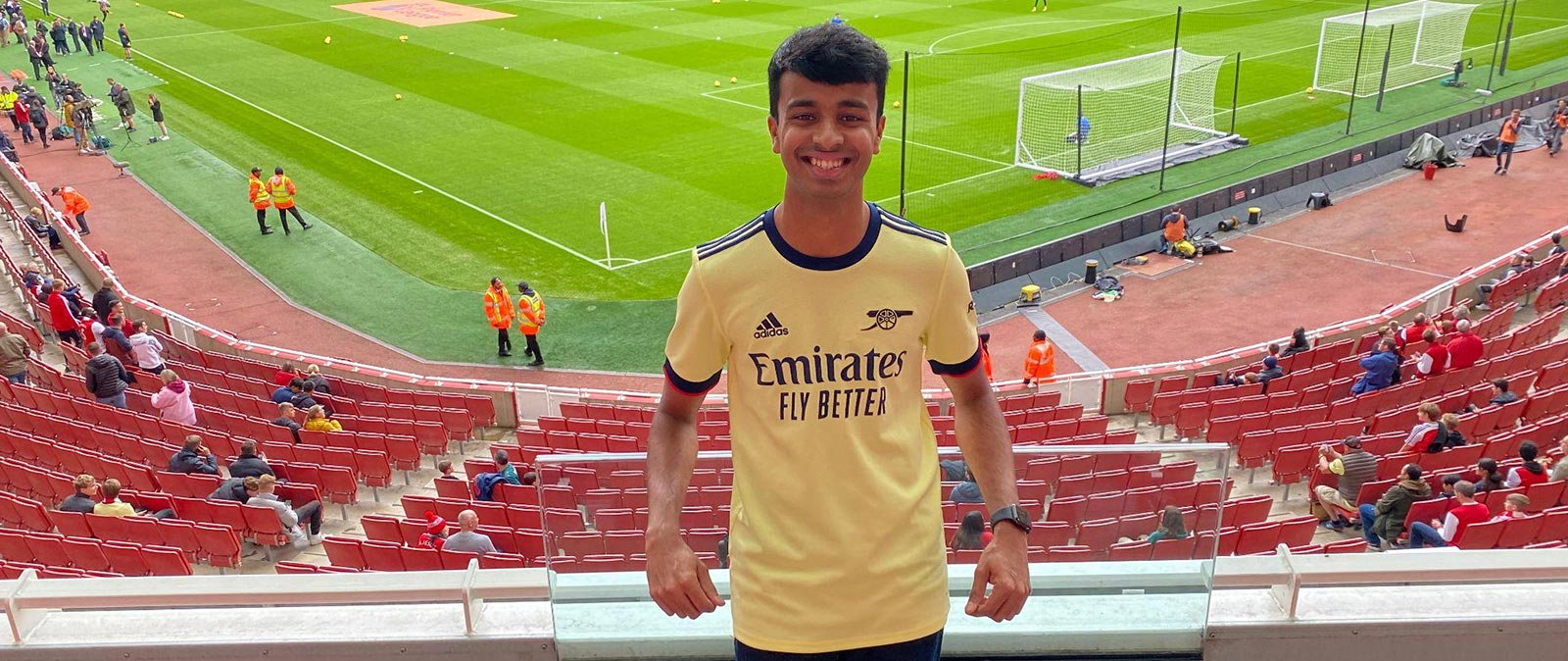
Atharva Shrivastava, FLAME Alumnus, Associate - Partnerships, Rajasthan Royals
An Academic Space for a Sportsperson: Finding the Intersection
I have always been deeply passionate about sports. From my earliest days of playing during childhood to eagerly following games on television, it has been a constant presence in my life. Over time, I found myself particularly drawn to the merchandise side of the industry, an interest that began quite early on. Conversations with seniors from school and family friends who were exploring careers in sports management helped me realize that this passion could evolve into a meaningful professional path.
FLAME University has played a defining role in shaping where I stand today. The university and its faculty recognized and nurtured my interests, creating an environment that encouraged me to explore them further. Their guidance and support gave me the confidence to pursue my aspirations with clarity and purpose
My passion for sport was evident in everything I pursued, particularly through the many dimensions of learning that FLAME offers. Almost every assignment I undertook carried a sports lens. For instance, while my classmates approached an economics assignment conventionally, I explored it through the intersection of sports and economics. Across courses, these assignments and projects became instrumental in shaping my CV, allowing me to demonstrate interdisciplinary knowledge while maintaining a consistent focus on sport.
Completing my dissertations and several research papers during my fourth year was certainly a boost to my ambitions with postgraduate studies.
Beyond Academics: Learning from the Field
Extracurricular activities and sports always supported this academic experience. I was dabbling in various sports, such as cricket, football, and volleyball, and also immersing myself in the management of sport to understand how the ecosystem works. Being a part of Kurukshetra, FLAME University’s flagship event, was a first-hand experience of organizing large-scale competitions; managing teams; and understanding the various dimensions of sporting events like sponsorships, security, logistics, marketing, finance, hospitality, etc.
A big part of the experience at FLAME is the community. You really get to learn from your peers and seniors and build a connection with them that stays even after you graduate. I created bonds with students across batches, especially in the field. It is only after graduating that you truly realize the value of pursuing your passion alongside people and trying new experiences that push you beyond your comfort zone.
Life after FLAME: Exploring New Horizons
Following my undergraduate studies at FLAME, I went to the UK to embark on a new challenge, an MSc in Sports Management from Loughborough University. Being one of the most reputed universities for sports management, it was an ideal stepping stone. During my time in the UK, I worked in hospitality for Premier League football clubs and in operations for the Vitality Netball Super League. My primary stint in the UK was as a Retail Supervisor at the Marylebone Cricket Club (MCC), which meant I was working at Lord’s Cricket Ground.
Being one of four team members in the retail, e-commerce, and merchandising departments of a multi-million dollar business gave me remarkable exposure at a very early stage in my career. Getting this head start through my academic background and hands-on experience was one of the best things to happen for my career in this field. It allowed me to connect my learnings with the sports industry in India while bringing back new perspectives and knowledge.
Working in the World of Sport: Insights and Takeaways
Each sport is unique, and every format has its nuances. I don't want to sound cliché, but I think working in the Indian Premier League (IPL) and being a part of such a large-scale franchise was a dream come true. It was entirely unexpected, and when the opportunity came my way, it became one of the defining moments of my young sporting career. I think what excited me most about working in sponsorships was the people that I was interacting with. In the sponsorship department, our role extended beyond prospecting and closing deals to actively servicing them. Across this entire cycle, I engaged with a wide range of stakeholders, particularly in the context of global sponsorships. These interactions significantly shaped how I read situations and navigate relationships.
Working with sponsors across diverse industries, each with distinct priorities and expectations, sharpened my people skills and deepened my understanding of stakeholder management. No two days are alike. The work demands agility, perspective, and responsiveness, and that constant variation is what makes the role so exciting.
Rajasthan Royals and NEOM, Saudi Arabia: Creating Societal Impact
One of the most significant projects I worked on as an Associate in Partnerships with the Rajasthan Royals was the NEOM–Rajasthan Royals partnership. Along with the team, we were responsible for delivering key programs across the partnership, including executing large-scale workforce engagement cricket initiatives that brought together over 3,000 participants across leadership, women, children, and the community in 2024 and 2025. My biggest learning from the NEOM partnership was understanding the profound value that sport, especially cricket, holds in people’s lives. It goes far beyond being just a game.
For me, it was a significant milestone. I began to truly grasp the impact of what we do and the meaningful role sports play in shaping individual lives. Working with NEOM was an eye-opening experience that deepened my perspective on the influence and responsibility that come with being part of the sporting ecosystem.
Laying the Groundwork: From First Job to Global Placement
Networking is especially important in the sports industry in India. Building strong relationships and staying connected can make a meaningful difference. If you already have a network, lean into it and seek guidance or opportunities through it. Securing that first break is often the most challenging step, as it is in any industry, and the right connections can help open that door. It is essential to be willing to put in the hard yards and take on the foundational work that comes your way. My first role in the sports industry was on the sales floor at Decathlon, where I worked for three months. While those early stages can feel demanding, and there are moments when you believe you are capable of much more, that phase is part of the journey. Everyone I look up to and many of my peers have gone through it. In many ways, it feels like a rite of passage.
Being open to long hours and occasional sacrifices is sometimes what it takes to build momentum in a competitive space like this. Those experiences, though challenging, lay the foundation for growth.
While I was certain that I wanted to build a career in sport, I believed that gaining international exposure early on would give me a meaningful head start. Regardless of your background or circumstances, securing that first opportunity is crucial.
In whatever way you can, take the initiative to get your foot in the door and set things in motion. Once you begin, momentum builds, and opportunities tend to follow.
Go Beyond the Passion: Cultivate Applicable Skills
In India, and across much of the world, sport inspires deep passion. Many of us grow up watching our heroes and playing the games ourselves. But passion alone is not enough to build a career in the industry.
This is something that often goes unspoken. Admiration and enthusiasm are a starting point, but turning that passion into a profession requires intent, skill, and sustained effort.
I could be the most passionate supporter of a player, a team, or a sport. But if I am not genuinely invested in the specific role I perform within that space, the work can quickly become challenging.
Passion for sport certainly matters, especially in an industry that demands long hours and personal sacrifice. Yet it is even more important to identify which aspect of sport you want to build your career in and to cultivate a deep commitment to that function. Sustainable success comes not just from loving the game but from loving the work behind it.
When it comes to any opportunities or interviews, I think you need to be crystal clear in terms of what you want to do. “I want to work in sponsorship in sport because I enjoy sponsorships as an industry,” or "I want to work in social media because I enjoy marketing,” helps you set clear intentions of the kind of work you want to do while remaining in the sports industry.
Living what many imagine to be the glamorous side of sport, connecting with cricketers, receiving team merchandise, or simply being associated with the IPL is not what brought me here. Nor is it what brought any of my colleagues here.
What truly matters is a genuine commitment to the work itself and the ability to create meaningful impact within that space. That, to me, is the core.
If you are passionate about a specific area, say merchandising, be intentional about building your presence in that space. Use platforms such as LinkedIn to connect with the right professionals and share thoughtful perspectives on sports merchandising and related trends. Over time, this signals genuine interest and depth of engagement.
When you reach out to someone, they can clearly see your focus and commitment. That clarity sets you apart. Many applicants simply say they are passionate about cricket, which is true for countless people. What distinguishes you is a defined interest and the consistent effort you invest in demonstrating it.
The Future of Sport: Adapting to Technological Advancements
Global sport is undoubtedly set to evolve in significant ways. I would not claim to know exactly how it will unfold, but the influence of technology is already evident. With AI tools such as ChatGPT and Gemini becoming part of everyday workflows, functions across sports, from social media to sponsorship, are increasingly integrating these tools. As consumers, we can already see this shift reflected in the kind of content being produced. The rise of AI further signals how deeply technology is shaping the business of sport.
For those entering the industry, the ability to adapt and remain flexible in the face of technological change will be essential. At the same time, technology does not replace human insight. An AI tool can generate a social media creative, but it still relies on the right prompt and a clear understanding of the audience. That human perspective remains critical.
It may sound familiar to say that one must cultivate a distinctive skill set, but in a rapidly shifting landscape, that distinctiveness truly matters. The way we consume sport is changing. Many fans no longer sit through an entire match with undivided attention. Instead, the game plays in the background while they scroll through short-form content on social media. Recognising these subtle shifts in consumer behaviour can influence how you position a sponsorship or craft a social media strategy. In a competitive industry, such insights can make a meaningful difference.